


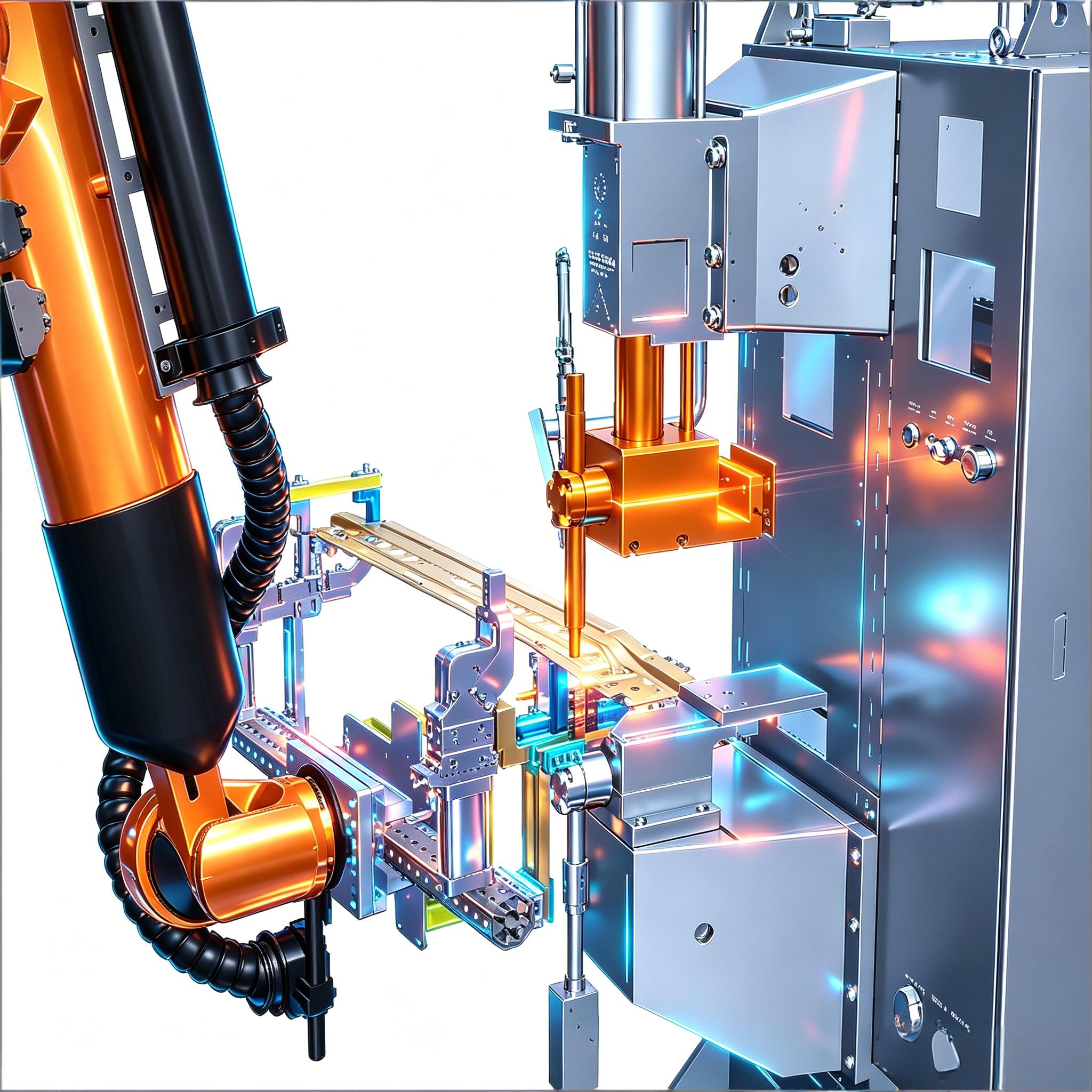
Projection welding is a precision branch of resistance welding. By pre-forming protrusions on the workpiece surface, the welding current is concentrated at these projections, which are melted by resistance heat and formed under compression. Its core features are precise heat generation, stable quality, minimal workpiece damage, and suitability for multi-point synchronous welding.
Compared with conventional spot welding, projection welding concentrates current and pressure on the pre-formed projections, resulting in an extremely small heat-affected zone. This effectively avoids thermal deformation and damage to thin-walled parts and precision components. Multi-point projection welding completes multiple welds in one operation, delivering far higher efficiency than single-point welding and supporting large-scale standardized production of power batteries. Welds are uniformly formed with consistent strength, free of spatter and incomplete fusion, fully meeting the stringent safety and quality standards for power batteries.
In power battery manufacturing, projection welding is a core process spanning the entire cell, module and PACK production flow, with applications focused on three critical components:
Explosion-proof valve welding on battery covers The explosion-proof valve is a safety pressure-relief device with a thin-walled aluminum structure. Projection welding uses low heat input to join the valve and cover precisely, ensuring stable sealing performance. The relief pressure is accurately controlled within the standard range of 0.4–0.7 MPa, preventing pressure-relief failure caused by thermal deformation and eliminating the risk of battery bulging or bursting at the source.
Battery tab and adapter plate welding Tabs are the core power-output components, mostly made of copper–aluminum composite materials. Projection welding achieves high-strength, low-damage joining between tabs and covers or adapter plates, guaranteeing stable electrical conductivity without abnormal contact resistance.
Nut, bolt and housing connection Nuts and bolts on power battery boxes and module frames are joined by projection welding to create non-loosening, high-strength connections that withstand long-term vehicle vibration and avoid safety hazards from fastener detachment.
Automation compatibility is the key to scaling projection welding for power battery mass production. Tailored to power battery production characteristics, Eunice offers two automated solutions:
Multi-station projection welding special machines: Ideal for high-volume production of standardized parts such as battery covers and tabs. With multi-point synchronous welding stations, one machine can produce up to 10,000 pieces per day, with positioning accuracy of ±0.05 mm to ensure consistent weld quality.
Robotic projection welding systems: Designed for flexible welding of large workpieces such as modules and PACKs. A 6-axis robot with a high-precision projection welding head, paired with a visual positioning system, flexibly adapts to different battery workpieces and supports rapid product changeover to meet the new energy industry’s demand for multi-variety, fast-iteration production.
Both solutions integrate an intelligent parameter control module that automatically adjusts welding current, pressure and time based on workpiece material and thickness, delivering stable and controllable processing.
The reliability of Eunice’s projection welding solution rests on three pillars: patented technology, rigorous quality control, and extensive industry experience.
Patented technology support: The company holds numerous invention and utility patents related to welding. For power battery projection welding, it has optimized core technologies including projection design, welding parameter control and thermal damage prevention, building an independent intellectual property barrier to ensure process advancement and stability.
Rigorous quality control: Certified to the ISO9001 quality management system, Eunice implements full-process quality control from incoming material inspection, equipment assembly and testing to welding process validation. Every projection welding system passes fatigue and destructive testing, with weld strength, sealing and electrical conductivity fully compliant with power battery industry standards.
Proven industry experience: With years of expertise in welding for automotive, construction machinery and new energy sectors, Eunice deeply integrates mature projection welding technology with power battery production requirements. It has delivered customized solutions to many battery manufacturers, building rich experience in thin-walled and precision-component welding, quickly responding to customer needs and resolving production pain points.
Safety is the bottom line in power battery manufacturing, and precision joining is the core prerequisite for safety. Eunice’s projection welding technology delivers precise, stable and reliable performance across all key power battery joining applications, boosting productivity through innovation and safeguarding safety via strict quality control.
Going forward, Eunice will continue to focus on upgrading power battery manufacturing processes, further refining projection welding technology and automated solutions to help customers improve product quality and efficiency. We will provide solid process support for the safe development of the new energy vehicle industry, so that every power battery is equipped with a stable and reliable “safety core”.
Related Posts
- ▶ EUNICE Provides Effective Solutions to Welding Pain Points in New Energy Vehicle Manufacturing
- ▶ EUNICE Robotics AI Intelligent Welding Solution Implemented, Enabling Full‑Process Unmanned Weld Inspection in Vehicle Manufacturing
- ▶ EUNICE Robotics Deepens Its Presence in New Energy Vehicle Welding, Customized Welding Workstations Adapt to Mass Production of Multiple Models
Online Message
Thank you very much for writing to us. Please leave your message and contact information, we will reply to you within 24 hours.