


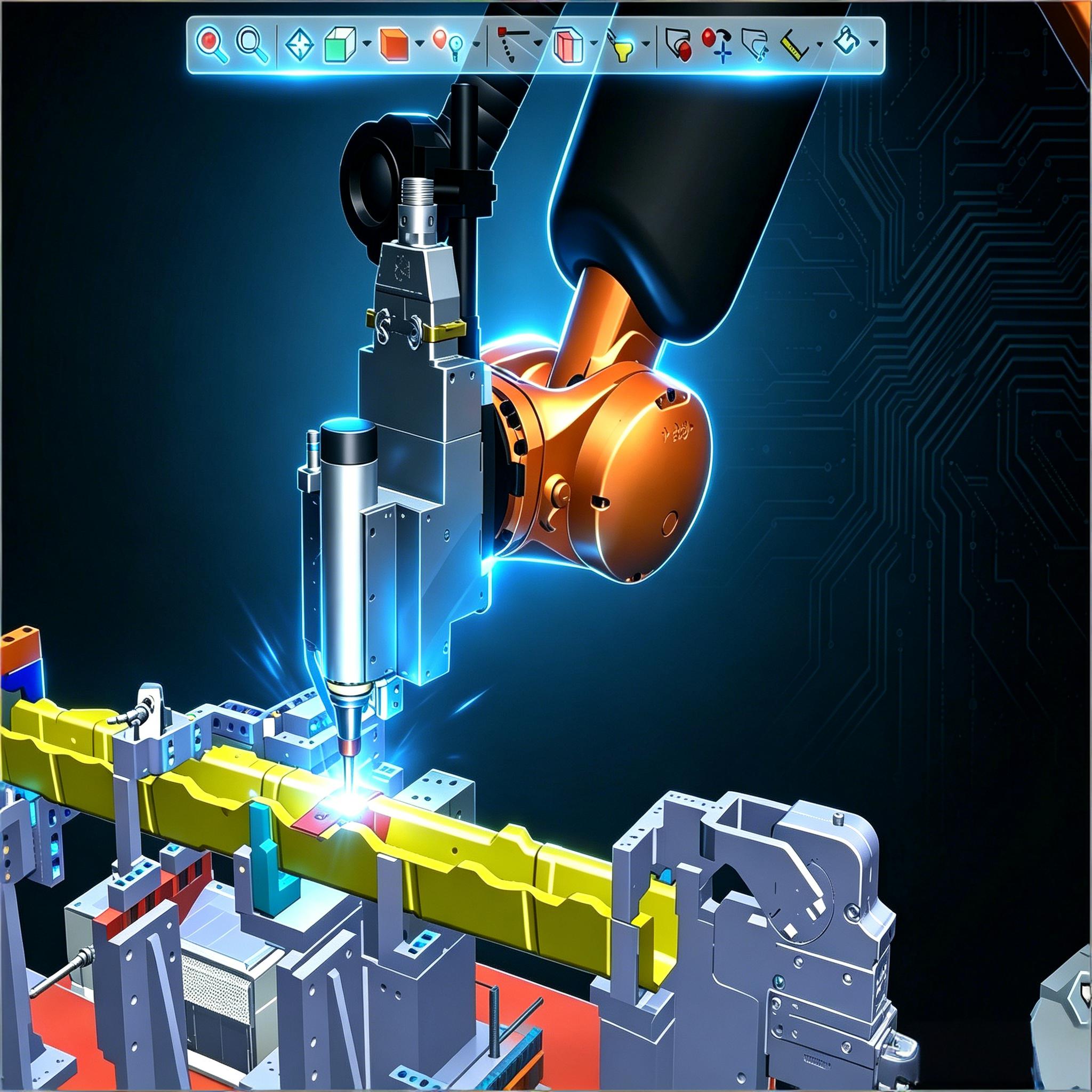
Stud welding is a precision welding process that melts the stud end and the workpiece surface via arc heating, then completes metallurgical bonding through instant pressurization. Its core features focus on three dimensions: high speed and efficiency, single-sided operation, and high strength & reliability. The welding cycle can be controlled within 0.5 seconds; a single station can process tens of thousands of welding points per day on average, fully matching the high-cycle production line requirements of over 60 JPH in the new energy industry. It requires no double-sided operation, making it perfectly suitable for enclosed or semi-enclosed spaces such as battery housings and vehicle body cavities. The joint is a full-penetration metallurgical bond with tensile strength reaching over 90% of the base metal. Its anti-vibration and anti-loosening performance far exceeds that of mechanical connections, eliminating the risk of loosening during long-term use. Meanwhile, it avoids drilling-induced stress concentration and preserves the structural integrity of sheet metal.
In the new energy sector, stud welding has covered core scenarios in power battery and vehicle manufacturing. In power battery production, it is mainly used in key processes such as fixing wire harness brackets inside the housing, installing cooling pipeline anchors, and connecting module end plates. Its low-spatter and low-heat-input characteristics prevent welding residues from falling into cells and causing short circuits, while meeting IP67 sealing requirements. In new energy vehicle manufacturing, it covers interior and exterior trim installation, door lock bracket fixing, sunroof guide rail base welding, high-voltage wire harness grounding terminal connection and other scenarios. It not only guarantees assembly accuracy but also improves the vehicle’s NVH performance and structural durability. Compared with traditional bonding and bolt fastening, stud welding requires no curing waiting or pre-drilling, directly cutting 2–3 processes and increasing overall production efficiency by more than 50%.
Automation upgrading is the core path for stud welding to adapt to large-scale new energy production. Eunice’s robotic stud welding system is built around 6-axis industrial robots, integrating intelligent welding guns, visual positioning, and adaptive parameter control modules to achieve flexible and high-cycle production of multi-variety workpieces. The system supports rapid model changeover; product switching can be completed within 10 minutes by importing welding programs for different workpieces, adapting to collinear production of multi-model battery housings and multi-vehicle body components. The visual positioning module automatically compensates for workpiece positioning deviations with a positioning accuracy of ±0.1 mm, ensuring precise placement of every welding point. Paired with multi-station rotating tooling, it achieves synchronous loading, welding, and unloading, further compressing the production cycle and solving the industry pain points of poor versatility and high changeover costs of traditional special machines.
The core competitiveness of Eunice’s stud welding solution comes from the company’s technological accumulation and full-process service capabilities deeply rooted in intelligent welding. In terms of technical support, more than 70% of the company’s staff are R&D personnel. Relying on the integrated R&D system of mechanics, electronics, computing, and software, the company has independently mastered core technologies such as adaptive welding parameter control, thermal deformation suppression, and low-spatter control. Equipped with high-precision welding power supplies, it ensures stable arcs and uniform penetration, adapting to various common materials for batteries and vehicle bodies such as carbon steel, stainless steel, and aluminum alloy. In terms of quality commitment, the company strictly follows the ISO9001 quality management system and implements full-process quality control from component selection, equipment assembly to commissioning and delivery. Each welding unit passes aging tests and strength verification to ensure stable continuous operation, with a welding point consistency rate of over 99.9%. In terms of case empowerment, Eunice has provided customized stud welding integration solutions for many leading new energy enterprises. Targeting pain points such as welding in narrow spaces of battery housings and flexible assembly of multi-variety vehicle body parts, the company optimizes robot trajectories and tooling design, helping customers reduce the welding time of a single battery housing by 40%, cut labor costs by 60%, and significantly improve product qualification rate and production safety.
As a professional service provider in intelligent welding and industrial automation, Eunice always takes customer needs as the core and deeply integrates technological innovation with industry scenarios. The stud welding solution not only solves the connection efficiency and quality problems in new energy production but also helps customers transform from extensive manual production to intelligent lean manufacturing with its automated, flexible and intelligent features. In the future, Eunice will continue to iterate stud welding technology, integrate AI algorithms and visual perception technology, further improve process accuracy and adaptability, and provide more efficient, reliable and intelligent connection solutions for the new energy battery and automotive manufacturing industries. With second-level fastening technology, we will consolidate the core foundation of new energy intelligent manufacturing.
Related Posts
- ▶ EUNICE Provides Effective Solutions to Welding Pain Points in New Energy Vehicle Manufacturing
- ▶ EUNICE Robotics AI Intelligent Welding Solution Implemented, Enabling Full‑Process Unmanned Weld Inspection in Vehicle Manufacturing
- ▶ EUNICE Robotics Deepens Its Presence in New Energy Vehicle Welding, Customized Welding Workstations Adapt to Mass Production of Multiple Models
Online Message
Thank you very much for writing to us. Please leave your message and contact information, we will reply to you within 24 hours.